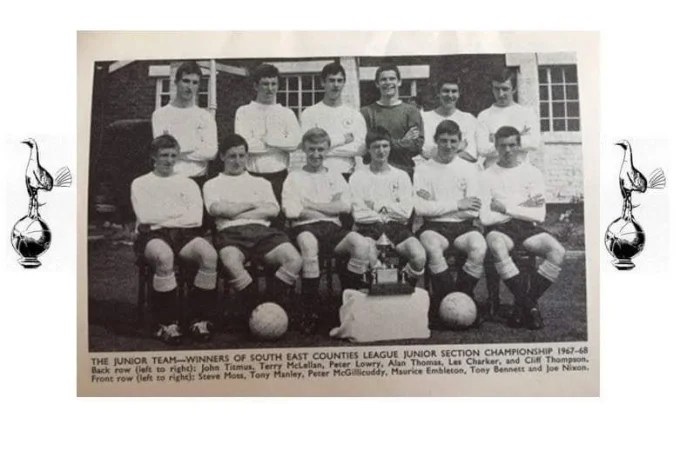
Barking born former footballer Joe Nixon signed for Spurs as an apprentice in 1966 and would play for the junior youth team, senior youth team and the A team, during his time at the club. Quick when running with the ball and skilful on it, Joe would spend a couple of seasons with Spurs during the mid to late 1960s, before being released by the club. He would play for QPR at reserve team level, and then move over to Australia, after spending a season with Romford, to sign for a team called South Sydney. Upon his return to England, Joe played one season with Barnet before finishing his playing career. I recently had the great pleasure of talking to Joe about his time at Spurs.
What are your earliest footballing memories?
Joe: My earliest memories are playing for my junior school in Barkingside, in Essex. Then afterwards I played football for the senior school, and later Ilford and Essex as a schoolboy, so there were some happy memories there.
What are your earliest memories of your time at Spurs? And how did you come about joining the club?
Joe: My dad was approached by Spurs’ chief-scout Dickie Walker after a county game, and I was probably 13 at the time. I was asked whether I’d be interested in going to Spurs as a schoolboy, and being coached in the evening. So for two years before I signed as an apprentice I used to go to White Hart Lane on a Tuesday and a Thursday to be coached. That was good except for the footballs that used to hang from the underside of the stand, and you used to have to run and head them, and it felt like you were heading a medicine ball sometimes. So they are my earliest memories of Spurs.
Did you have any footballing heroes/inspirations and if so who were they?
Joe: I always thought of George Best as probably the most skilful player that I’ve ever seen. So George Best was the one, but from the point of view of somebody that you could look up to as being at the same club that you were, well Dave Mackay was without a doubt a leader. Not just because he was the captain of the team, but he led by example, and if he said something then nobody argued.
Who were your greatest influences at Spurs?
Joe: Dave Mackay would be the one, but I also used to like watching Cliff Jones, as although he was an older player he had a work ethic when he was there. He wasn’t one of those who joked around all of the time, and although he did have a laugh and a joke, everything that he did regarding his football, he took seriously. I thought that he was a bit of a role model.
Could you describe to me what type of player you were? And what positions you played in during your time at Spurs?
Joe: I was a winger who was quite quick, and although I wasn’t as quick as some of the other players, I could run at almost the same speed with the ball. So I had some pace running with the ball. I wasn’t that good defensively and I didn’t sort of think that it was up to me if someone played a poor pass to you. So while I didn’t think that my attitude then was bad, looking back on it I think that I should have put in a little bit more than what I did.
Were there any players at Spurs who you would watch closely to try and improve your game or look to learn from?
Joe: Of the ones that were around with the crowd that I played with I thought that the couple who would go on to do well because of their attitude and their ability was Ray Evans, who I always thought was a solid player. Some people have bad games now and then, but Ray wouldn’t. He might not be as good as some of the others, but he generally wouldn’t have a bad game. So he was one player, but in the first team at that time the player who impressed me most for being very consistent was Philip Beal. He never seemed to get flustered and he didn’t panic or do anything really wrong on the pitch. It was just always a steady game when Phil was there. So I would try and watch those two players to see what they did, and that was pretty ironic as they were both defenders, while I was pretty useless at defending, albeit later in my career I ended up playing as a defender. Playing as a defender felt so easy that I wondered to myself why I didn’t move back a bit on the pitch when I was younger, because I had a bit of pace, could tackle and I could also read the game well.
What was your time at the Lilywhites like on the whole?
Joe: It was good from the point of view that I was full-time as an apprentice, and that I got into the routine of turning up at the ground and doing whatever you had to do before getting on the coach, to go to Cheshunt. So it was a good way of when you left school, of having some responsibility of things that you had to do, but I wouldn’t say that my time at Spurs in terms of football was my happiest. I had an injury which had torn the ligaments in my ankle, and so I was in plaster for six weeks and so I had to recover from that. However, they weren’t the happiest times because really I don’t think that I was strong enough then, to sort of stand up for myself. So when people were taking the mick which was always going to happen at a football club, sometimes the banter was a bit over the top, but if you were someone who would stand up for themselves, then you were sort of accepted, but I didn’t. And the more that I didn’t do anything, the more it happened. So at that time I didn’t think that it was in my nature to really stand up for myself. But with regards to the football side of things, I played with some great players and I thoroughly enjoyed playing for the youth team and also the odd game in the A team.
What was the greatest moment of your footballing career?
Joe: I would say that the greatest moment wasn’t actually in this country. I went to Australia in June 1972, and I was there until September 1975. In 1974 we (South Sydney) won the Australian equivalent of the FA Cup, and that match was televised and it was great getting the cup afterwards, with a good crowd of between 25,000 and 30,000. The hairs on the back of your neck would stand up in that game, and it was just a terrific and really enjoyable experience.
Could you talk me through some of your favourite memories or ones which stand out from your time in the Spurs Youth side and A team?
Joe: We had some really good games when everyone played really well and everyone was happy about it, although there were odd times when it wasn’t. One standout memory was when we were running around the track at White Hart Lane and Johnny Wallis was out with us, and there was an entrance from the side of the pitch to the gym. The physio Cecil Poynton had shouted to Johnny to send one of the lads in, and so Johnny selected me to go to the gym. During those days when someone told you to do something, then you didn’t argue. So he told me with his voice raised to get in there now, after I’d asked him why. So I said alright and went into the gym and it’s the first team who are in there, and I’m looking around and there was Dave Mackay, Jimmy Robertson, Alan Gilzean and Cliff Jones. So I thought blimey this is great, and so we’re playing two touch football and as I get the ball and roll it off Terry Venables came in strongly and gave me a bit of a clatter, and so a few words were spoken. The reason why I’d went in there in the first place was because there’d been an argument and so someone was told to go the shower to cool off. So two or three minutes later I get the ball and thought I’ll lay it off straight away this time, which I did, but Terry Venables once again clattered me! So Dave Mackay came over to Terry Venables and got his shirt and turned it around, tearing the shirt to pieces before throwing him along the wall. He then shouted at him to go back to Chelsea!
After that had happened in the gym, Bill Nicholson had said that that was it and that everybody had to finish up and have a shower to cool off. I’d only been in there for about three minutes and I’d been clattered twice and it was already finished. So that was my lasting memory of training with them, but it was a shame that it didn’t last any longer, although I won’t forget playing football in the gym with those guys. I can also remember playing in a game for the A team, and Brian Parkinson was playing. He was a very, very skilful player, and so I was thinking blimey if someone like that was not progressing further ahead then he was a year ago, then at that time I felt a bit sad really, as he was just so good. I can also remember being in the changing room, and Jimmy Greaves had been on the cinder track at the ground, and as he came in he took his boot off and it had red cinder all on it, so he put it behind and so there was a bit of it on the wall. He then called Johnny Wallis and said to him had anybody cleaned the changing room? To which Johnny replied that Joe had done it. He then asked Jimmy why he was asking, and Jimmy, who was joking around said that he didn’t want to cause any trouble said that it was fine, but Johnny then started having a go at me about the red cinder that was on the floor. Jimmy found it amusing which it was, and to be honest it was the kind of thing that I could see myself doing! Although I thought oh no! As I would have to clean up the changing room again.
I can also remember when Spurs beat Chelsea 2-1 in the 1967 FA Cup final, which was a great day. Afterwards when we all went for the meal, there was at the time a bit of an embarrassing moment for me with the cutlery, as me and a few of the other young lads before hands were trying to work out how to properly cut the food, but thankfully in the end we were alright!
Who was the toughest player that you ever came up against?
Joe: The toughest player was probably Phil Holder when I was playing for QPR reserves against Spurs, when I went back to Spurs. And Phil was playing at left-back, with me playing on the right flank as a winger. About only five minutes in to the game the ball got passed out to the right, and I was about four inches taller than Phil at least. As the ball came up in the air I thought that I was going to win it, when I felt his studs on the top of on of my calves. And then there was an elbow over my shoulder, and so he’d only got there above of me because his studs were on my calf, and I couldn’t believe that the referee hadn’t seen what he’d done. So Phil would have been one of the hardest players and one of the most aggressive players that I ever came up against in my career.
Were there any players at Spurs who you were particularly close to?
Joe: Spurs was very competitive then so everyone was competing with each, even though they were all mates. So they didn’t want to help each other. I wouldn’t say that I was particularly close to anyone, even though you had players who were good mates, like Phil Holder and Terry Shanahan, and also Phil Holder and Steve Perryman. I did know Peter McGillicuddy, who was a nice guy, but I had more actual friendships when I went to QPR. The players there wanted you to do well, and so it was two really different atmospheres at the two clubs.
Could you talk me through your career after you left the Lilywhites and what prompted you to leave the club?
Joe: I left Spurs because they released me and so I wasn’t signed on for another year. So I left Spurs and went to QPR, who I had a couple of years at, mainly in the reserves. I did however, play for the first team in things like a testimonial or a friendly. So I did get to play with some really good players in the reserves, as you had first team players playing for the reserves after coming back from injury. The most skilful player who I ever played with was Rodney Marsh, who played for the reserves for 20 minutes or so with me. He was incredibly skilful and just so good that he could take the mick out of players on the pitch, and he was just a tremendous player. After leaving QPR I spent a season with Romford, but I didn’t like it at all! The referee often couldn’t control the games. The only good thing about being there was playing against John Charles, who was in his late 30s/early 40s then. I’ve never seen anyone head a ball like him, as it was just absolutely unbelievable, and he was just an exceptional player. I later went to Australia to join South Sydney, and during those three or so years I was playing first team football and playing competitive football.
During my time in Australia I actually got picked to play for the Australian Under 21 side, but when they asked me about it I never gave it a thought. I immediately said that I was English, but what I should have done was said yes and that that would he great. Because if I had wanted to play for them then I could have taken up citizenship, but I enjoyed my time in Australia. My final team upon my return to England was Barnet, and I liked my time there. But it was just too much, playing football for Barnet and also having a job at the same time. So in the end I had to make a choice that if I didn’t think that I was going to make it in football, and then in my mid 20s I had a young family and so I needed to earn some money. So it was a decision that I didn’t really have a lot of choice in.
What would your advice be to the young Spurs players of today as they look to rise up through the ranks at the club?
Joe: I would say that if I’ve learnt anything, then that’s that you shouldn’t assume that you’re not good enough. You’ve got to go in there and believe that you’ve got the ability and have the work ethic, a bit like Steve Perryman, then there’s no reason why you can’t make it and get as far as you should do. So my advice is to have a bit of confidence in your own ability, and believe that you deserve to be there.
After all these years how do you look back on your time at the Lilywhites and is Spurs a club that you still hold close to your heart?
Joe: My endearing memory of being at Spurs is actually feeling very proud of wearing that Spurs shirt and having everything one else thinking that those players play for the Spurs youth team. So even though it never amounted to anything I understand what people would give to have been in my position.
 superhotspur